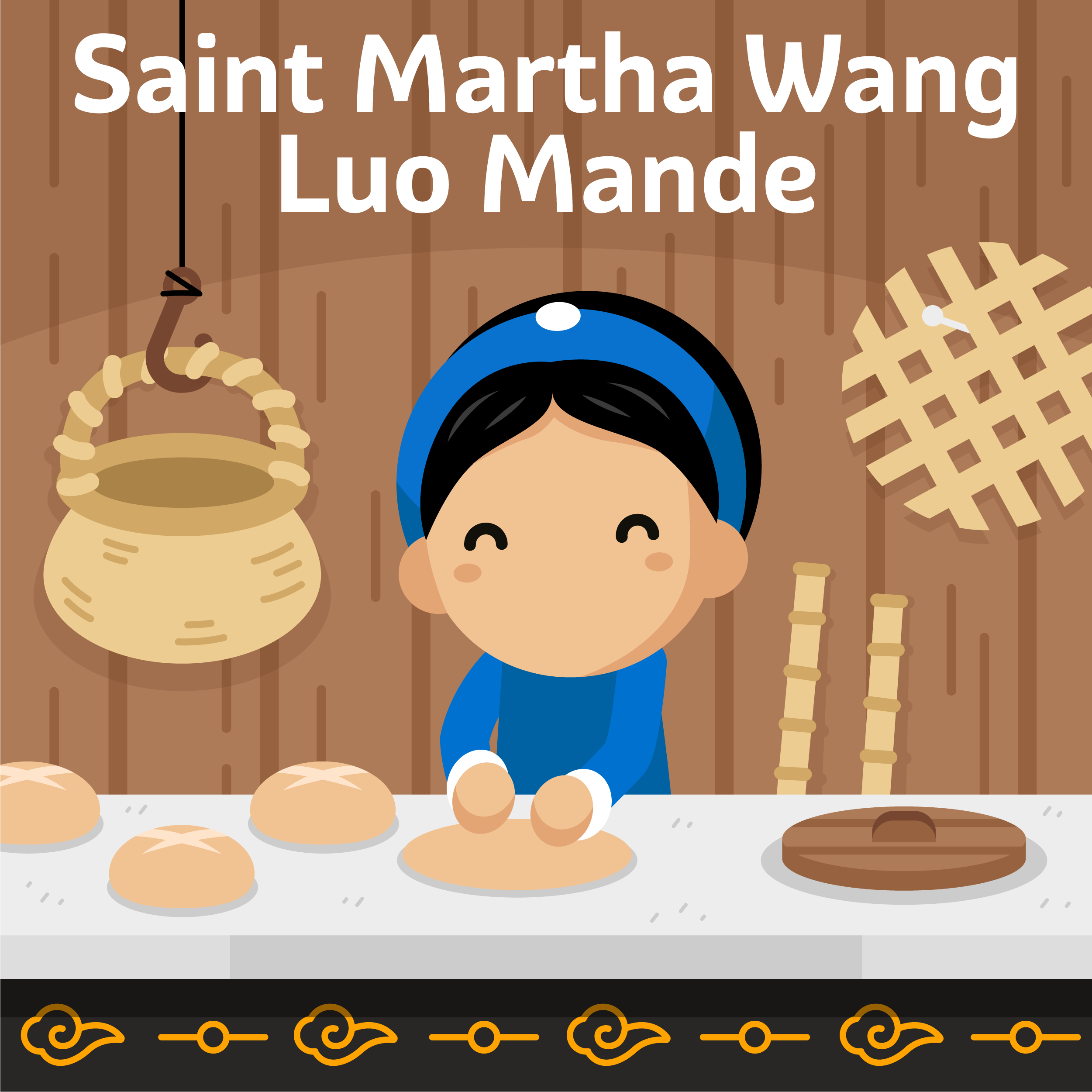
Saint Martha Wang Luo Mande was born in China in 1821. She grew up and married. She and her husband had no children of their own, but they adopted two nephews.
After her husband died and her children were grown, she started a small inn. Running the inn meant doing lots of cooking and cleaning. Saint Martha was especially good at making Chinese steamed buns. A Catholic teacher came to the inn and taught her about the Catholic faith. Saint Martha Wang was baptized a Catholic on Christmas Day in 1852. She was 51 years old.
Saint Martha Wang wanted to live her Catholic faith, so she moved to a new city, Guiyang, where she could go to Mass every day. The bishop of Guiyang hired her to be a cook and cleaner for the seminary, the school for men studying to be priests.
In 1861, the local government of Guiyang was very anti-Catholic. The police arrested three of the seminarians and sentenced them to death. Saint Martha Wang visited the imprisoned seminarians and brought them food. On the day they were to die, Saint Martha Wang walked with them. Because of this, she was arrested as a Catholic and executed with the seminarians.
Saint Martha Wang can help us remember that simple tasks such as household chores are an excellent way to serve our Lord. She teaches us that our Catholic faith is a great gift, and that no one is too old to learn about Christ or do great things in His name.